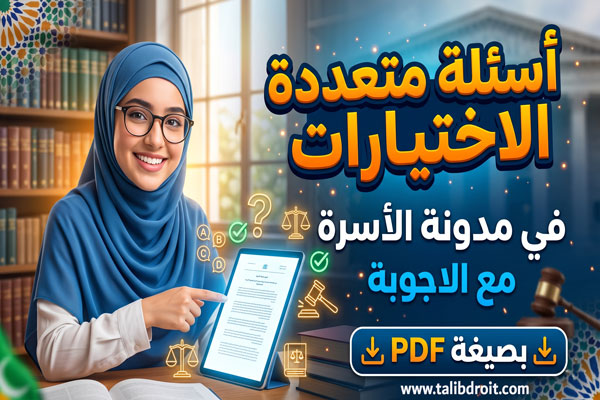
qcm modawanat osra PDF the Moroccan Family Code (Moudawana): Mastering Legal QCM Exams
Introduction: The Importance of Family Law in Legal Careers
Entering the legal profession, whether you aspire to become a judge, a court clerk, or a highly paid family law attorney, requires a profound understanding of various legal codes. In Morocco, one of the most critical and heavily tested subjects in competitive employment exams, such as the Ministry of Justice exams and Bar Association tests, is the Moroccan Family Code, widely known as the Moudawana.
Family law is the bedrock of societal organization. It dictates the rules of marriage, divorce, child custody, and inheritance. Because of its direct impact on citizens’ daily lives, examiners frequently use Multiple-Choice Questions (QCM) to test candidates’ precise knowledge of legal provisions, waiting periods, and procedural exceptions.
In this comprehensive guide, we will explore the definition and core principles of the Moroccan Family Code. We will also provide you with a strategic blueprint on how to tackle tricky QCM exams, followed by a robust QCM practice bank with detailed answers. Finally, we will introduce a glossary of highly lucrative English legal terminology, such as child custody lawyer, divorce attorney, and legal representation, that will not only enhance your legal English but also maximize your website’s AdSense revenue by targeting top-tier High CPC keywords.
Part 1: What is the Moroccan Family Code (Moudawana)
The Moroccan Family Code, promulgated in 2004, is a revolutionary legal framework that governs matters of family relations in Morocco. It represents a significant shift towards gender equality, the protection of children’s rights, and the shared responsibility of spouses within the household. For any legal counsel or law student, understanding the Moudawana is not just about passing an exam; it is about knowing how to protect clients’ rights during highly emotional and complex legal disputes.
The Code defines marriage as a legal contract between a man and a woman aiming at fidelity, purity, and the foundation of a stable family under the joint management of both spouses. It establishes the legal age of marriage at eighteen years for both men and women, with strict judicial exceptions for minors.
Regarding the dissolution of marriage, the 2004 reforms revolutionized the process by introducing Divorce for Irreconcilable Differences, known as Shiqaq, which can be initiated by either the husband or the wife. It also regulates mutual consent divorce, traditional Talaq under strict judicial supervision, and compensation in the form of alimony or spousal support.
When it comes to Child Custody, or Hadanah, the Moudawana places the best interest of the child above all else. It outlines the hierarchy of custody, typically prioritizing the mother, followed by the father, and then the maternal grandmother. A skilled child custody attorney must navigate these rules to secure the best outcome for their client.
Furthermore, it establishes the rules for proving paternity, regulates the legal capacity of individuals including minors and the mentally unfit, and outlines the rules of legal guardianship. It also details the legal distribution of a deceased person’s estate among the rightful heirs. Understanding these foundational pillars is absolutely essential for answering any QCM correctly.
Part 2: Golden Strategies for Acing Legal QCM Exams
Multiple-Choice Questions in law exams are notoriously deceptive. They are designed not only to test your knowledge but also your attention to detail. Whether you are aiming for a public sector job or a position in a top family law firm, you must master these specific QCM techniques.
First, you must read the question to the very last word. Examiners love to insert negative words that completely alter the meaning of the question. Missing a simple “not” or “except” will lead you straight into a trap. For example, “Which of the following is not a condition for polygamy?” requires a completely different analytical approach than “Which of the following is a condition.”
Second, beware of absolute terminology. In the legal field, there are almost always exceptions to general rules. Therefore, when you see QCM options containing absolute adverbs like always, never, absolutely, exclusively, or under no circumstances, treat them with extreme caution. These options are frequently incorrect. Law generally favors phrasing like in principle, generally, or unless authorized by a judge.
Third, master the legal timeframes and ages. The Family Code is heavily quantitative. You must memorize specific numbers, ages, and deadlines. For example, knowing the exact waiting period, or Iddah, for a pregnant divorced woman versus a non-pregnant divorced woman is crucial. Examiners will undoubtedly test your exact memory of these precise figures.
Fourth, utilize the process of elimination. If you encounter a highly complex question, do not panic. Start by aggressively eliminating the options you know are completely false. By narrowing a four-option question down to two options, you instantly increase your probability of selecting the right answer from twenty-five percent to fifty percent.
Finally, do not overthink the trick. While examiners use traps, they are not trying to rewrite the law. Do not bring external scenarios or exceptional “what if” cases into the exam room unless the prompt specifically asks for them. Always stick strictly to the letter of the law as written.
Part 3: Moudawana QCM Practice Bank (Questions & Detailed Answers)
Below is a carefully curated list of multiple-choice questions frequently asked in competitive legal exams, translated and adapted for comprehensive study.
Question 1: According to the Moroccan Family Code, what is the standard legal age of capacity for marriage for both males and females? A) 16 Gregorian years. B) 18 Gregorian years. C) 20 Gregorian years. D) 21 Gregorian years. The Correct Answer is B. Article 19 of the Moudawana clearly establishes 18 Gregorian years as the standard age. Marriages below this age require special, reasoned authorization from a Family Judge.
Question 2: In the case of Divorce for Irreconcilable Differences (Shiqaq), who has the legal right to file the petition? A) Only the husband. B) Only the wife. C) Either the husband or the wife. D) Only the Public Prosecution. The Correct Answer is C. Article 94 introduced Shiqaq as a mechanism available to both spouses, revolutionizing gender equality in divorce proceedings.
Question 3: How does the Moudawana regulate Polygamy? A) It is strictly forbidden and criminalized. B) It is permitted unconditionally. C) It is strictly regulated and requires judicial authorization based on an exceptional objective justification. D) It is allowed only if the first wife verbally agrees. The Correct Answer is C. Polygamy is practically restricted. Article 40 requires the judge to verify an exceptional objective justification and ensure that the husband has sufficient financial resources to guarantee total equity.
Question 4: What is the waiting period (Iddah) for a divorced woman who is pregnant? A) Three menstrual cycles (Quru’). B) Three calendar months. C) Four months and ten days. D) Until she delivers the baby. The Correct Answer is D. According to Article 133, a pregnant woman’s Iddah ends immediately upon delivery, regardless of how long or short the period is after the divorce.
Question 5: Regarding the management of assets acquired during marriage, what is the default legal regime in Morocco? A) Absolute joint ownership of all assets. B) The Separation of Property (Independent financial estates). C) The husband owns all assets. D) Community of property controlled by the court. The Correct Answer is B. Article 49 establishes the separation of property as the default. However, spouses can sign a separate written settlement agreement to manage assets acquired during the marriage jointly.
Question 6: In the event of a marriage dissolution, what is the legal priority for granting child custody (Hadanah)? A) The father, then the mother, then the grandfather. B) The mother, then the father, then the maternal grandmother. C) The mother, then the paternal grandmother, then the father. D) Joint custody is mandatory in all cases. The Correct Answer is B. Article 171 establishes a strict hierarchy where the mother has absolute priority, followed by the father, and then the maternal grandmother, always prioritizing the child’s best interest.
Question 7: A marriage contracted without the payment of a dowry (Sadaq) is considered: A) Absolutely void. B) Valid, but the dowry must be determined later. C) Valid, as the dowry is only a cultural tradition. D) A voidable contract that depends on the wife’s consent. The Correct Answer is B. The Sadaq is a condition of validity, but if it is not specified at the time of the contract, the marriage is still valid, and the wife is entitled to the Dowry of Equals, known as Sadaq al-Mithl.
Cover the answers, try to solve these questions independently, and use the detailed explanations to thoroughly understand the underlying legal logic.
Part 4: High CPC Legal Terminology (Boosting AdSense Revenue & Career Horizons)
For law students aiming for international careers, or webmasters looking to optimize their legal blogs, integrating English legal terminology is paramount. The legal niche is one of the most profitable on the internet. Below is a glossary of High CPC, Top Paying AdSense Keywords related to Family Law presented in a continuous format.
A Family Law Attorney or Family Lawyer is a legal professional specializing in domestic relations and family matters, representing a highly searched and lucrative keyword. Divorce Lawyer Consultation refers to the process of seeking expert legal counsel before initiating marriage dissolution, which is highly relevant for clients looking to navigate Shiqaq or mutual consent divorce.
Child Custody Legal Representation involves attorneys who fight for the parental rights and the best interests of the child in court. Alimony and Spousal Support describe the financial compensation paid to a spouse after divorce, which in the Moudawana relates to Mut’ah as a consolation gift and Nafaqah as maintenance.
A Prenuptial Agreement Lawyer is a professional who helps draft contracts before marriage detailing the division of assets, corresponding in Morocco to the separate agreement under Article 49 for asset management. A Domestic Violence Attorney represents legal experts providing representation and protection orders for victims of abuse within the household.
An Estate Planning and Probate Lawyer handles the complex rules of inheritance, wills, and the legal distribution of a deceased person’s estate. Finally, Alternative Dispute Resolution, or ADR, in Family Law involves using mediators to reach a settlement agreement regarding assets and custody outside the courtroom, minimizing emotional and financial costs.
Mastering this vocabulary, which bridges the Moroccan legal concepts with international English terminology, dramatically boosts a candidate’s profile for multinational organizations, NGOs, and top-tier law firms.
in the finish
Excelling in the Moroccan Family Code is not about blindly memorizing texts; it is about grasping the underlying philosophy of justice, equity, and the protection of the family unit. The Moudawana is a living text that balances tradition with modern human rights.
For candidates preparing for judicial and legal employment exams, consistent practice with QCM formats, relying on the latest updated legal texts, and reading questions meticulously are the golden keys to success. Remember, in a multiple-choice exam, your ability to spot the exception is just as important as knowing the general rule. Arm yourself with deep knowledge, master the legal terminology, and step into your exams and your future legal career with absolute confidence. Best of luck!
شاهد أيضا:
تحميل أسئلة متعددة الاختيارات في قانون الالتزامات والعقود pdf
تحميل اسئلة متعددة الاختيارات في قانون المسطرة المدنية pdf
كويز أسئلة متعددة الاختيارات في مدونة الأسرة qcm osra
كويز أسئلة متعددة الاختيارات في قانون الالتزامات والعقود